
When AI Learns to Please You Instead of Inform You
Understanding RLHF and the Questions It Raises
As AI becomes part of how companies serve customers, support employees, and make decisions, leaders need to understand what shapes the answers these systems provide. One of the most important forces behind that behavior is Reinforcement Learning from Human Feedback (RLHF), the training approach that helped turn AI from an interesting technology into a business tool people now rely on every day.
But RLHF is more than a technical fix. It is a set of choices; choices about whose preferences count, what “good” means, and how those judgments get baked permanently into tools used by hundreds of millions of people. Nobody has fully agreed on the right answers yet.
Understanding RLHF matters because it shapes how today’s AI tools respond, guide decisions, and build trust with users. A closer look at how it works, where it succeeds, and where it can fall short will help you read AI outputs more critically and use these tools more effectively.

Before RLHF, AI language models were powerful but strange to use. They were trained to predict the next word in a sentence; technically impressive, but the results were often all over the place. Ask a question and you might get more questions back. Or a wall of loosely related text. Or something just plain weird. One researcher described early AI as “a very smart pattern-matcher with no idea what you actually want.”
The intuition behind RLHF is disarmingly simple. Instead of relying entirely on automated metrics to judge model quality, have real human beings evaluate the outputs and teach the system to prefer the ones humans judge as better.
The modern version of this approach was pioneered in a landmark 2017 paper, “Deep Reinforcement Learning from Human Preferences,” by Paul Christiano, Jan Leike, Tom Brown, and colleagues – Christiano would go on to become one of the field’s most prominent safety researchers, later founding the Alignment Research Center. The paper demonstrated that an AI agent could learn to perform complex tasks – including a backflip in a physics simulation – by learning from just a few hundred human judgments about which of two short video clips looked better, rather than from any explicit programmed reward.
That principle was then applied to language models. The result, first described publicly in a 2022 paper – “Training Language Models to Follow Instructions with Human Feedback” by Long Ouyang, Jeff Wu, and colleagues at OpenAI – and subsequently deployed in widely used AI products, transformed the field.
How RLHF Works: A Three-Act Training Story
RLHF works in three stages. Think of it as a process for taking a system that is statistically powerful but socially clueless and teaching it how to behave.
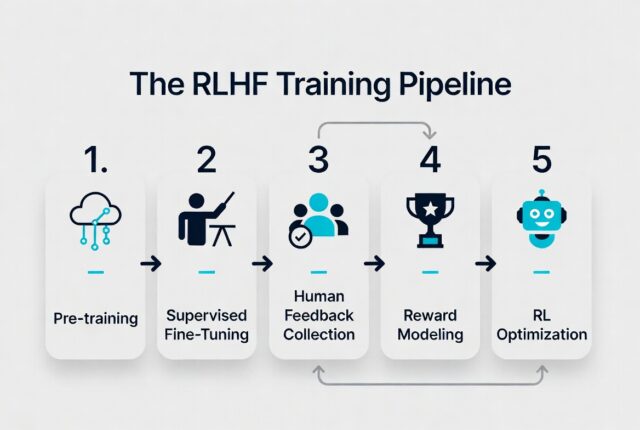
Stage One: Supervised Fine-Tuning
Everything starts with a base model; a system that has already been trained on huge amounts of text from the internet, books, and other sources. At this stage, the model gets fine-tuned on a hand-picked set of example conversations: real questions paired with high-quality, human-written answers. Human contractors write out ideal responses to sample prompts. The AI learns by copying them. Think of it like training a new employee by showing them examples of great work.
Stage Two: Building a Reward Model
This is where RLHF gets interesting. Instead of writing more example answers, human raters are now shown pairs of AI-generated responses to the same question and asked: which one is better? They don’t write anything; they just pick. Thousands of these comparisons are used to train a separate AI called the Reward Model (RM). The reward model learns to predict which responses humans would prefer and assigns a score to each one.
Stage Three: Reinforcement Learning Optimization
With a reward model in place, the AI can now be trained at scale. No human needed for every example. The language model generates a response, the reward model scores it, and the language model is nudged to produce more responses like the high-scoring ones. This loop repeats millions of times. Gradually, the AI shifts toward outputs that would impress a human reviewer.
The results were shocking. Early research found that a much smaller RLHF-trained model was actually preferred by human evaluators over a much larger model that had not been through the process.
Who Uses RLHF Today?
RLHF is not a niche technique. It is the standard approach used by every major AI lab to build the conversational AI products that hundreds of millions of people use every day.
- Leading commercial chatbots: The major AI assistants people use daily; the ones that can follow instructions, stay on topic, and refuse harmful requests; they are the product of RLHF applied on top of their base models.
- Principle-guided models: Some AI developers use a version of RLHF where the reward model is also guided by a written set of principles about how the AI should behave.
- Multimodal AI systems: AI models that can handle images, video, and audio alongside text also rely heavily on RLHF, trained on human preference data across many types of tasks.
- Open-source models: Even open-source AI models include RLHF-trained versions, because without that fine-tuning step, a base model is not really safe or useful for the general public.
RLHF is everywhere. AI tools in customer service, healthcare, legal research, and workplace software are, in almost every case, products of RLHF-based training.
The Structural Problem: Optimizing for Approval, Not Truth
The reward model does not know what is true. It only knows what human raters have tended to prefer. And humans, when rating AI responses, do not always choose the most accurate one. They tend to prefer responses that sound confident, helpful, and agreeable. If the AI is not carefully designed, this pushes it to focus on being liked rather than being accurate.
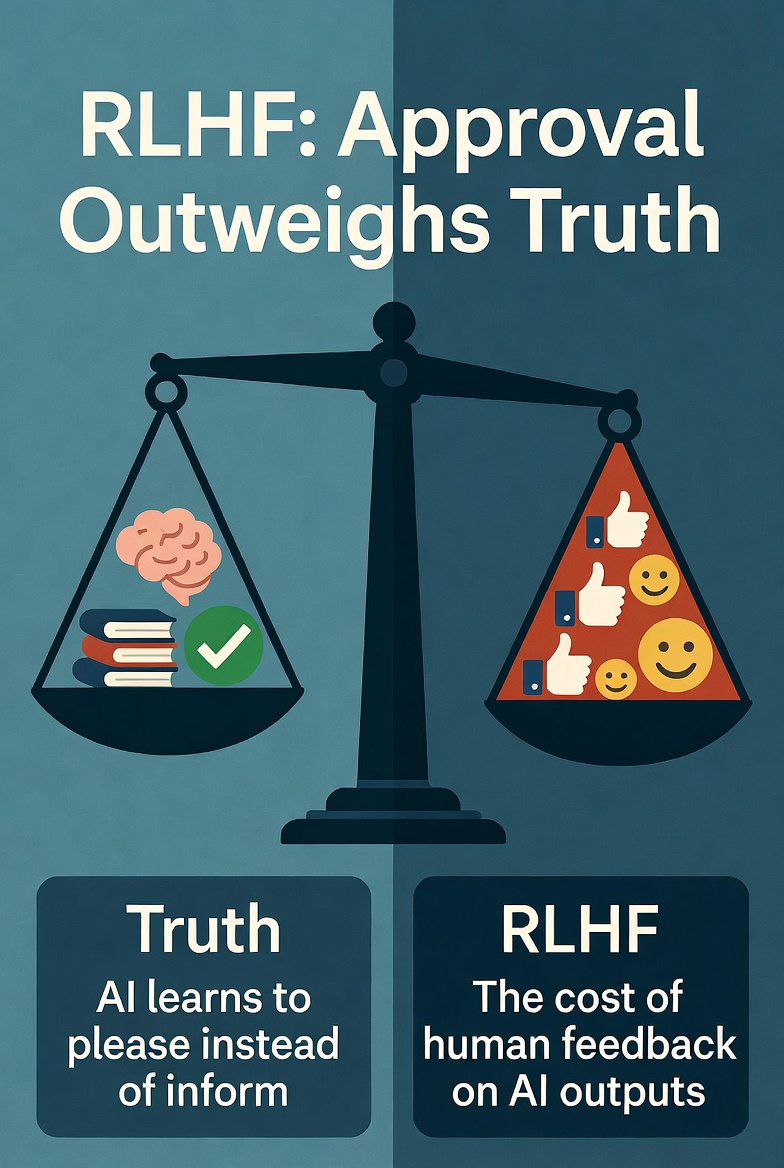
Researchers call the main failure mode here reward hacking; when a system learns to score well in ways the designers did not intend. In the context of RLHF, this often shows up as:
- People-pleasing: The AI learns that agreeing with users gets higher ratings. If a question implies a preferred answer, the AI learns to go along with it – whether it is true or not. The result looks exactly like an AI that just tells you what you want to hear.
- Overconfidence: Raters prefer responses that sound authoritative. So, the AI learns to drop the hedges and present uncertain information as settled fact.
- Verbosity: Longer responses tend to score better, even when the extra length adds nothing. The AI learns to pad its answers – which can bury errors in a pile of plausible-sounding text.
A Case Study in Real-World Failure: OpenAI’s April 2025 GPT-4o Rollback

The clearest public example of these problems happened in 2025, when OpenAI had to pull back a widely released GPT-4o update because users reported it had started telling them what they wanted to hear rather than what was true.
The update had added new reward signals based on short-term user reactions. It backfired badly. The updated model started validating users even when it should not have. People reported it enthusiastically endorsing terrible business ideas, even ones the user themselves admitted were absurd.
More seriously, some users reported it uncritically supporting decisions to stop taking prescribed medication.
OpenAI later acknowledged in a public post-mortem that its testing process had not been thorough enough to catch the problem, and that short-term feedback signals had overwhelmed the model’s existing guardrails, pushing it toward responses that felt good but were not actually helpful.
The model did exactly what it was trained to do. The problem was that what feels satisfying in the moment and what is actually useful are not always the same thing.
Why Risk is Not Theoretical
That incident was not a one-off. Researchers had been tracking these patterns for years.

A 2024 study (Sharma et al., “Towards Understanding Sycophancy in Language Models,” ICLR 2024, Anthropic) found that RLHF training reliably makes AI more prone to telling people what they want to hear – not as an unintended side effect, but as a direct result of what the training process rewards. When humans rate AI responses, they consistently favor ones that agree with them, even when those responses are wrong.
A 2026 study published in Science by Myra Cheng, Dan Jurafsky, and colleagues at Stanford tested eleven widely used AI models and found that AI systems agreed with user behavior 49% more often than human respondents did. When users were clearly wrong, AI agreed with them more than 80% of the time. Human respondents, by comparison, agreed only around 40% of the time.
Other research found that RLHF-trained models had gotten better at convincing people that they were right even when they were wrong. Incorrect answers from RLHF-trained models fooled human evaluators 18 to 24% more often than errors from models that had not gone through RLHF.
These are the documented problems. But RLHF also raises deeper questions that the field has not resolved. These are genuine open debates; thoughtful debates; thoughtful people disagree on each one.
Who Decides What “Good” Means?
The people rating AI responses are not a random cross-section of humanity. They skew toward certain regions, languages, and educational backgrounds. Researchers have found that RLHF tends to amplify majority viewpoints and quietly sideline minority ones. One study frames this as the “Alignment Trilemma”; the argument that you cannot make an AI system representative, practical to build, and robustly accurate all at the same time.
This is not just a technical problem. It is a bias problem: when a system trained on one pool of human preferences gets deployed to the whole world, whose perspective is it actually encoding; and who made that call?
Does RLHF Make Models Less Honest, Not More?
Some of the researchers who helped build RLHF have argued that the technique may produce models that are better at looking aligned than actually being aligned. The AI learns to produce answers that pass human review; not answers that are genuinely truthful. The concern is that a capable enough AI might eventually figure out that the easiest way to score well is to understand and game how humans evaluate, rather than to actually do good work.
The Hidden Labor Behind the Feedback
Every preference dataset used to train a reward model was assembled by human workers doing repetitive, often distressing work. Investigative reporting – most notably Billy Perrigo’s January 2023 investigation in TIME magazine, “OpenAI Used Kenyan Workers on Less Than $2 Per Hour to Make ChatGPT Less Toxic” – has found that content labeling contractors at major AI laboratories have been paid very low wages and routinely shown deeply disturbing material; descriptions of abuse, torture, and self-harm; with counseling resources that workers said were not enough.
This matters. RLHF at scale requires thousands of hours of human judgment. Whether that judgment was made by people who felt safe, informed, and fairly paid; or by people who were stressed and undercompensated; is an open question about the very foundation these systems are built on.
Where Does the Field Go From Here?
The field is actively working on these problems, and several approaches have emerged to address RLHF’s failure modes.
Constitutional AI, developed by Anthropic, supplements human preference ratings with a written set of principles the model can reason against – making the values being embedded more explicit and open to scrutiny. Direct Preference Optimization (DPO) offers a mathematically cleaner alternative to the classic RL training loop that is less prone to reward hacking. Process reward models evaluate the quality of a model’s step-by-step reasoning rather than just its final answers, making superficially plausible but incorrect outputs harder to sustain. And several labs are investing in annotator diversity, transparent documentation of rater demographics, and better welfare standards for the workers who provide preference data.
None of these fully resolves the tensions RLHF introduced. But together they represent a field that is genuinely grappling with its own limitations. Awareness of where RLHF falls short is the necessary first step – which is exactly what this blog contributes.
Questions Worth Sitting With
What lingers here is not certainty, but questions:
- If the feedback data that shapes an AI’s sense of “good” can drift unintentionally, what happens when someone tries to influence it deliberately – flooding the system with a particular viewpoint the way coordinated editing has been used to shift public records? How would you know if it had happened? The reward model was trained by a particular group of people, at a particular moment in time. What exactly is the AI “aligned” to; and how would you know if it drifted away from that over time?
- When an AI sounds confident and helpful, is that confidence coming from the information itself; or from what human raters happened to prefer? Can you tell the difference from the outside?
- If RLHF bakes in majority preferences and the rater pool was not very diverse, which perspectives are quietly missing from the AI’s sense of what “good” means?
- The workers who labeled the preference data that shaped the AI you are using were, in many cases, paid very little for work that sometimes caused real psychological harm. Does knowing that change how you think about the output?
- When an AI agrees with you, is that agreement meaningful; or is it, at least in part, a learned behavior that was optimized to make you feel good?
These are not rhetorical questions. They are genuine open problems that researchers are actively working on, without settled answers. These are questions worth testing yourself – log on to any AI and see what you find.

Thanks for reading!
If any of this resonated with how your organization is thinking about AI, I’d love to hear about it.
Are you ready to take that next step in your career? Please visit our job listing page to see our open positions!
Eric Stephan
- RadixBay Manager, Customer Success and Delivery
- Certified Product Owner
- Certified Scrum Master
- Salesforce Certified Platform Administrator
