
HaloITSM and Salesforce Agentforce IT Service: A Service Lifecycle Perspective
How Two Leading Platforms Support End-to-End Service Delivery
Modern ITSM decisions are no longer about choosing a single tool—they’re about designing a service architecture that balances speed, intelligence, and control. AI-driven service experiences promise dramatic efficiency gains, but operational rigor remains essential for reliability, compliance, and scale.
In Part 1, we explored the foundational differences between HaloITSM and Agentforce IT Service – one built on ITIL governance, the other on conversational, agentic AI. Now we go deeper – examining how each platform supports service operations across the complete lifecycle, from how requests enter the system through resolution, reporting, and continuous improvement
Both platforms offer powerful workflows, automation, and service delivery capabilities, but they take different approaches, and their differences and where they might complement each other become clearer when their processes are examined end-to-end.
1. Intake Channels: How Service Requests Begin
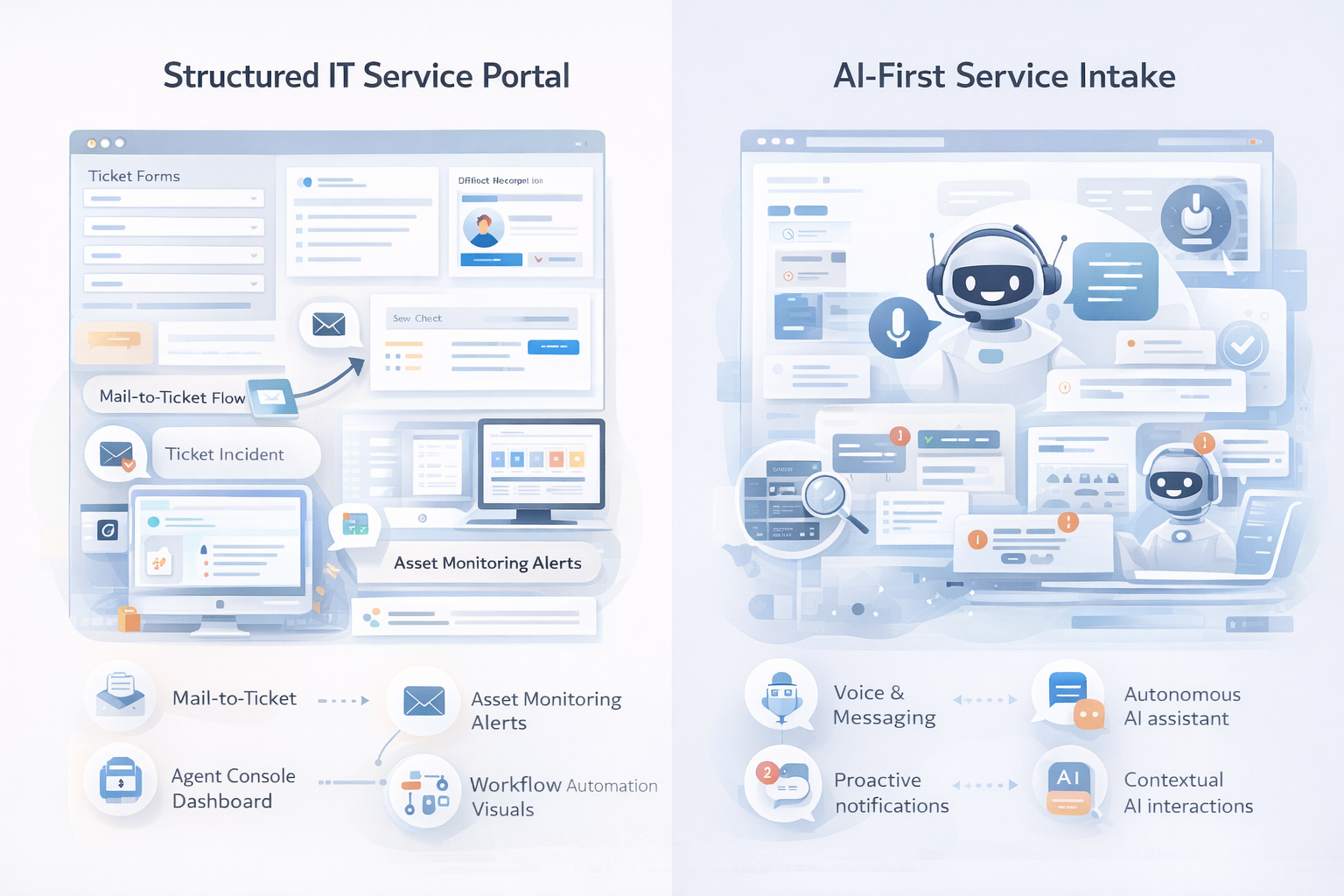
HaloITSM: Structured IT Intake
HaloITSM is built for IT operations:
-
-
- ITIL-aligned service portal
- Email-to-ticket
- Agent console
- Automation for routing and triage
- Asset-related auto-detection (hardware alerts, monitoring tools)
- Catalog-driven request forms with approval routing
- Virtual agent for initial triage
-
The service portal is optimized around IT service categories, with classification that feeds directly to ITIL processes and SLA tracking.
Agentforce IT Service: Conversation AI-First
Agentforce takes a different approach:
-
-
- Natural language chat
- Autonomous AI agents
- Proactive outreach by agents
- Voice and messaging channels
- Context-aware interactions.
-
The key differentiator: many requests never become tickets. AI agents resolve issues conversationally, escalating to human agents only when necessary.
2. Triage, Assignment & Routing
HaloITSM: ITIL-Driven Routing
-
-
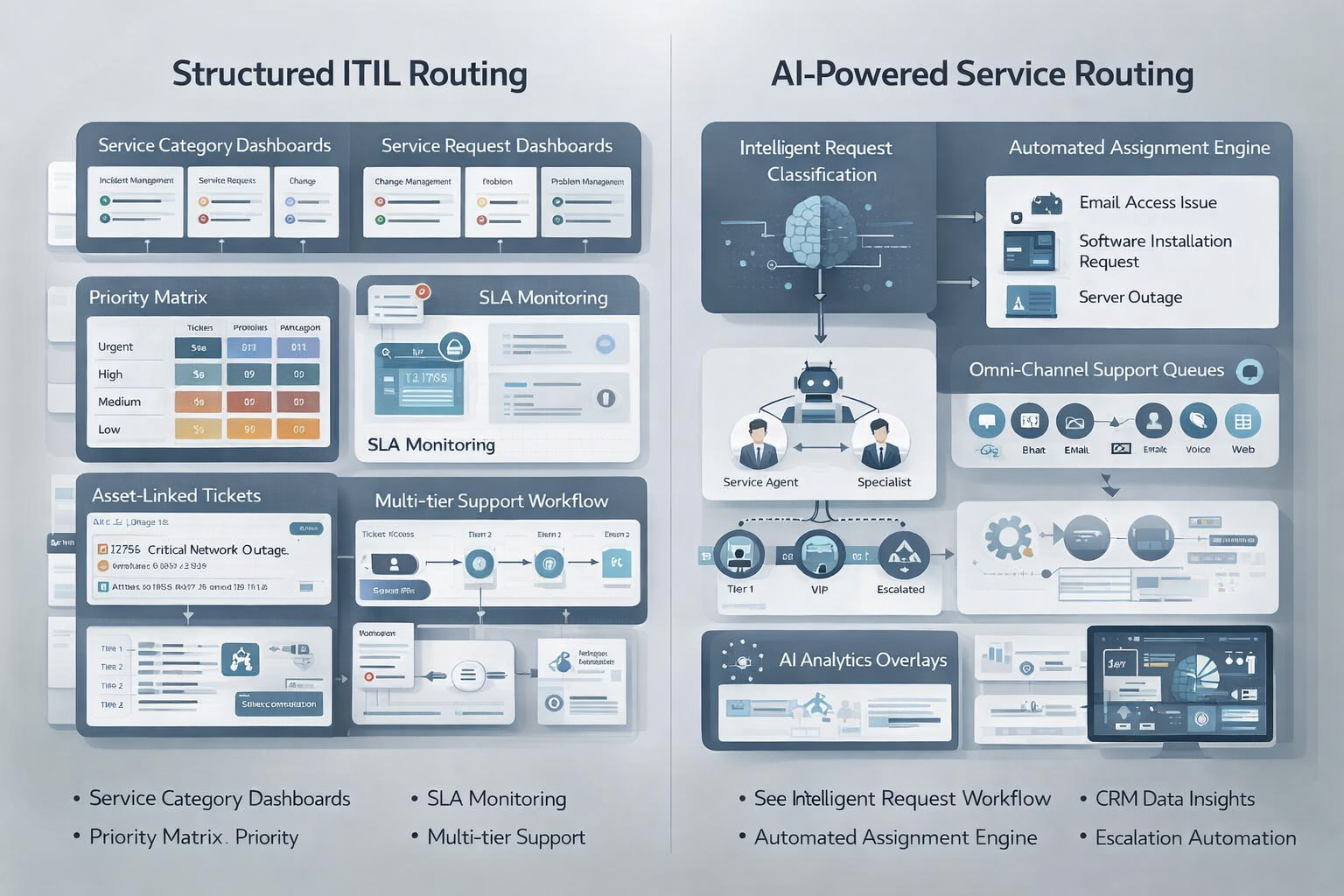
- Predefined service categories
- Priority matrices based on impact & urgency
- SLA targets
- Skill-based routing
- Asset or configuration associations
- Multi-tier support structures
- AI-powered auto-linking to detect similar tickets and consolidate major incidents
- HaloITSM’s routing supports complex IT organizations, MSPs, and high-volume IT operations.
-
Agentforce IT Service: AI-Powered Intelligence
-
-
- AI request type recognition
- Einstein-powered assignments
- Omni-Channel work queues
- Skills-based routing
- Automated escalation
- CRM data integration for VIP prioritization
-
Routing decisions can incorporate employee data – tenure, role, location, department- stored in Salesforce for prioritization.
3. Investigate & Diagnose
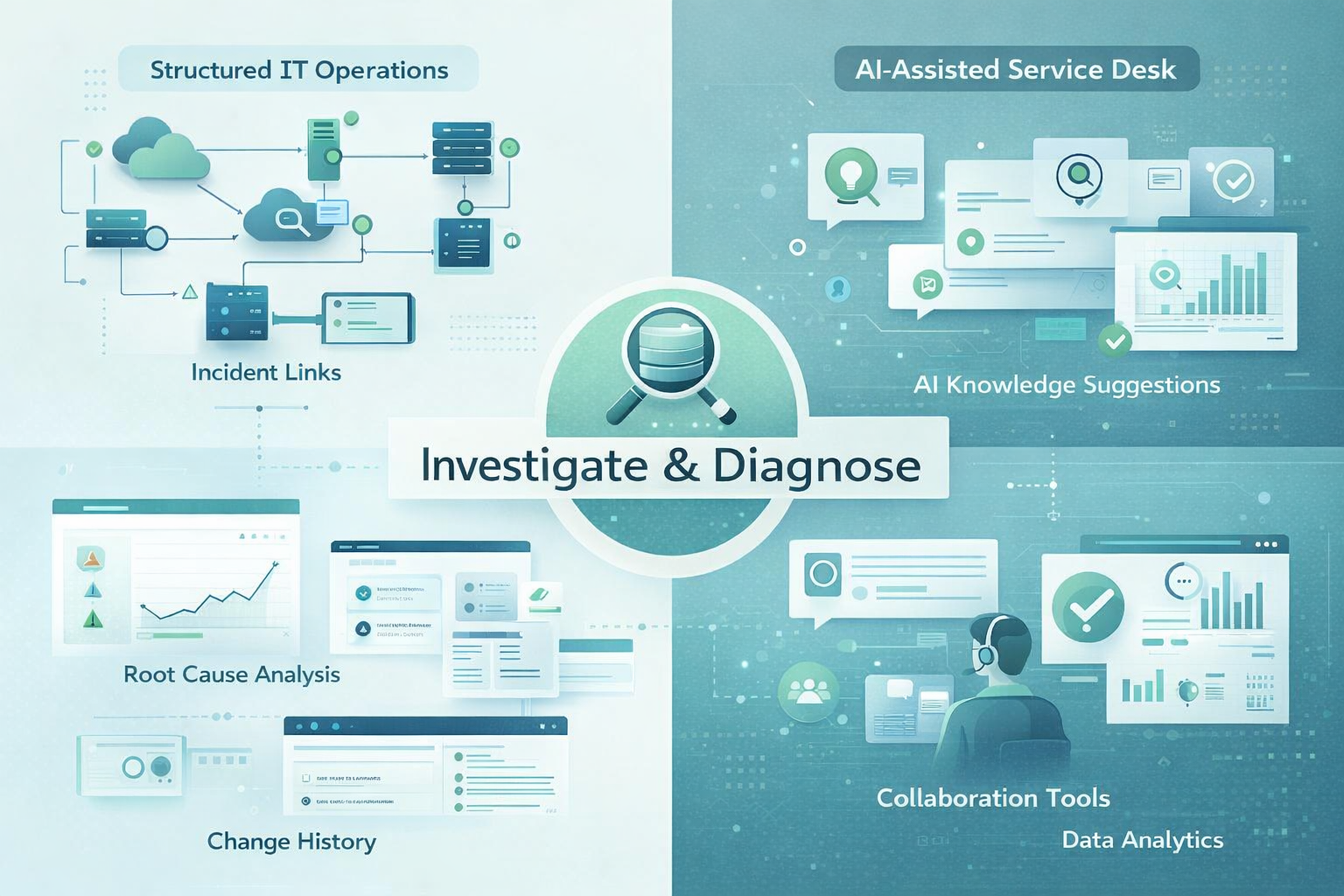
HaloITSM: Operational Root Cause Analysis
Investigation is ITIL-aligned and operationally focused:
-
-
- CMDB relationships to identify items and dependencies
- Linked incidents and major incident handling
- Problem records
- Known error database
- Change history affecting services impacted
- Major incident management
-
This enables root cause analysis and risk-aware decision making.
Agentforce IT Service: AI-Assisted Resolution
Diagnosis uses AI and Salesforce data:
-
-
- AI-powered knowledge recommendations
- User context from Salesforce CRM
- Einstein articles
- Automated diagnostic scripts
- Collaboration through Slack/Teams
- Chatbot-suggested resolutions
-
AI agents handle classification, routing, assignment, summarization, and root cause analysis to help IT teams get ahead of issues.
Key Difference: HaloITSM supports operational stability through structured root cause analysis. Agentforce accelerates resolution through AI pattern matching and knowledge delivery.
4. Fulfilment or Resolution

HaloITSM: Orchestrated IT Operations
Resolution execution integrated deeply with IT operations:
-
-
- Standard change workflows
- Emergency change processes
- Service request fulfillment
- Technician dispatching
- Asset updates
- Release coordination
- Approval workflows
- Integration with provisioning tools
-
HaloITSM manages the complete lifecycle, including changes that affect infrastructure, applications, and business services.
Agentforce IT Service: Automated Employee Service
Fulfillment focuses on user interaction and service completion:
-
-
- AI autonomous resolution
- Knowledge-driven self-service
- Integration-triggered actions
- Human agent handoff
- Multi-department collaboration through Salesforce records
-
Automate common IT requests—password resets, application provisioning, hardware requests—freeing IT teams to focus on strategic, high-value projects.
5. Change, Release & Configuration Management
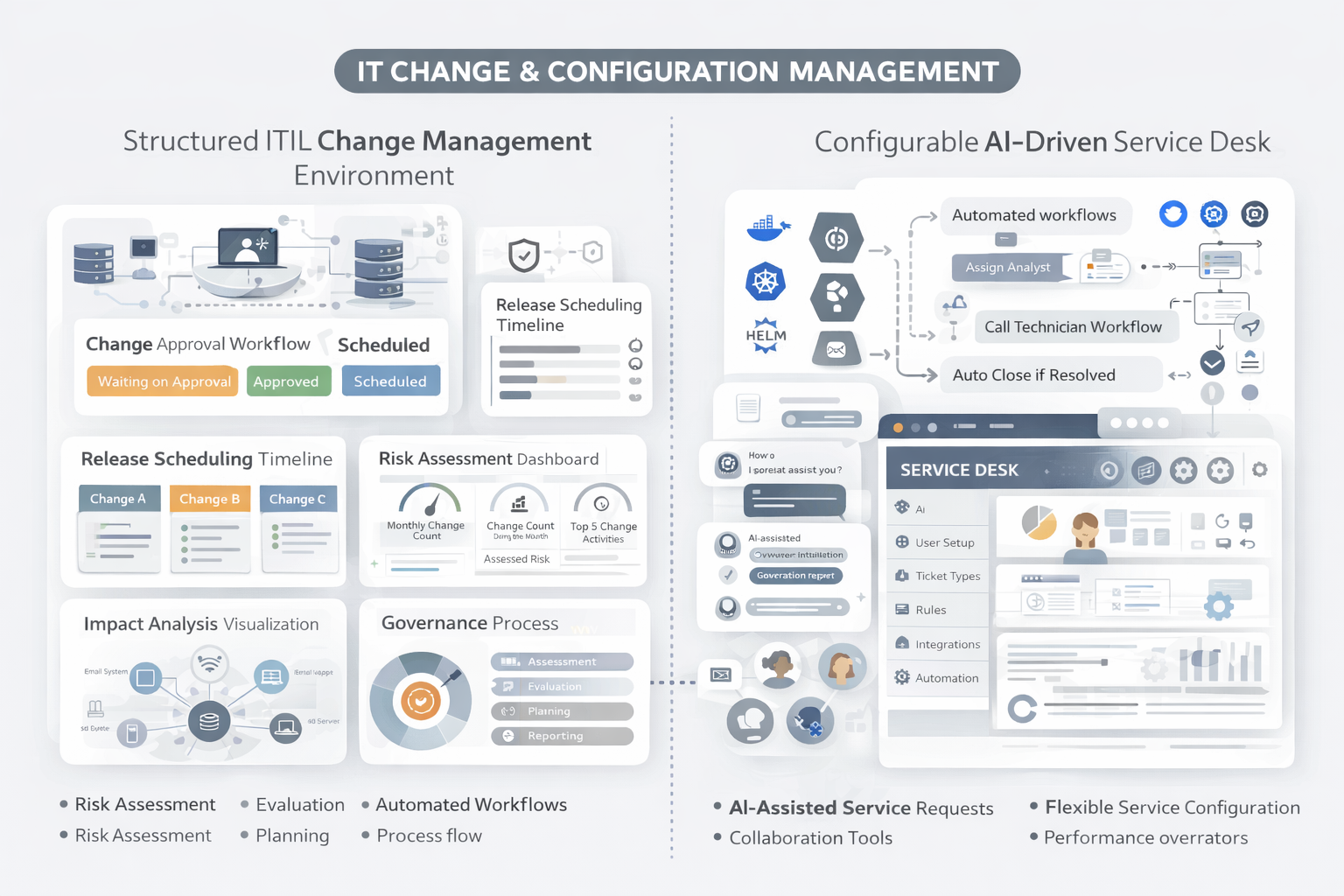
This is where the platforms diverge significantly.
HaloITSM: Enterprise-Grade ITIL Change Management
HaloITSM includes native ITIL change management:
-
-
- Complete CMDB
- CAB (Change Advisory Board) workflows
- Risk assessment
- Release scheduling
- Impact and collision detection
- Post-implementation review
- Blackout planning
-
It supports the full ITIL 4 service value chain for operational risk management.
Agentforce IT Service: Configurable Service Desk
Agentforce provides an IT Service Desk with ITIL alignment, but change management requires configuration:
-
- Included:
-
- Agentic CMDB
- Change request management
- Custom workflows using Flow Builder
- Integration with DevOps tools
- AppExchange extensions
-
- Requires custom build:
-
- Formal CAB workflows
- Risk assessment matrices
- Collision detection
- Release calendars
-
- Included:
Insight: For organizations requiring structured change control and mature CMDB, HaloITSM offers production-ready features. For organizations focused on employee service automation with lighter governance needs, Agentforce provides capabilities that can be extended.
This is where HaloITSM and Agentforce IT Service can complement each other:
-
-
- HaloITSM manages change control and infrastructure governance
- Agentforce handles employee-facing AI interactions and intake
- Integration allows seamless handoff between them
-
6. Reporting & Continuous Improvement

HaloITSM: IT Operation Metrics`
Designed for IT operational insights:
-
-
- MTTR, MTBF (Mean Time to Repair/Failure)
- SLA breach analytics
- Change success rate
- Incident trend analysis
- Major incident metrics
- Service availability
-
HaloITSM offers IT-specific dashboards out of the box with baseline ITIL KPIs.
Agentforce IT Service: AI Performance & Analytics
Leverages Salesforce’s reporting engine:
-
-
- AI agent performance and deflection rates
- Agent productivity
- User satisfaction (CSAT) integrated with surveys
- Channel usage and preference analytics Resolution rates
- Cross-service analytics
-
Salesforce analytics are flexible and can correlate IT service data with CRM, HR, and other business data.
Strength: HaloITSM offers purpose-built ITIL reporting. Agentforce provides broader, more flexible analytics that connect IT services to business value.
Process Capability Comparison
| Process Area | Halo ITSM | Agentforce IT Service |
|---|---|---|
| Incident Management | ⭐⭐⭐⭐⭐ Complete ITIL support |
⭐⭐⭐⭐ AI-driven workflows |
| Service Request Management | ⭐⭐⭐⭐⭐ Catalog-driven |
⭐⭐⭐⭐⭐ AI-powered |
| Problem Management | ⭐⭐⭐⭐⭐ Root cause focus |
⭐⭐ Requires custom build |
| Change Management | ⭐⭐⭐⭐⭐ Full ITIL with CAB |
⭐⭐ Custom workflows required |
| Release Management | ⭐⭐⭐⭐ Integrated |
⭐ Requires integration |
| Knowledge Management | ⭐⭐⭐⭐ Built-in |
⭐⭐⭐⭐⭐ AI-powered knowledge |
| AI / Autonomous Agents | ⭐⭐⭐ Automation-focused |
⭐⭐⭐⭐⭐ Agentforce-native |
| Self-Service | ⭐⭐⭐⭐ Portal-based |
⭐⭐⭐⭐⭐ Conversational AI |
| CRM / Business Integration | ⭐⭐ API-based integration |
⭐⭐⭐⭐⭐ Native Salesforce integration |
| Cost Predictability | ⭐⭐⭐⭐⭐ Transparent pricing |
⭐⭐⭐ Multiple pricing models |
| Implementation Speed | ⭐⭐⭐⭐⭐ 4–8 weeks typical |
⭐⭐⭐ Varies by scope |
Which Platform Works Best for Your Organization?
Organizations can find value in deploying both platforms in complementary roles
Agentforce IT Service serves as the employee-facing layer:
-
-
- Conversational AI for common requests
- Self-service password resets, access requests, knowledge
- Integrate into Slack/Teams where employees work
-
HaloITSM serves as the operational arm:
-
-
- Formal incident, problem, and change management
- CMDB and asset lifecycle management
- Complex request fulfillment
- ITIL governance and audit compliance
-
What’s Next?
Understanding how these platforms operate is important – but choosing the right approach requires a well-thought-out decision process.
In Part 3, we will introduce a decision framework that helps organizations evaluate service platforms based on business priorities.
Interested in exploring how HaloITSM and Agentforce IT Service could work together in your organization? We can help.

Thanks for reading!
If your organization is ready to steer toward smarter IT solutions, we’re here to help you chart the course.
And if you’re looking to grow your own career journey, check out our open roles — your next adventure might be with us.
Eric Meares
HaloITSM Certified Administrator
AT*SQA Certified Software Tester
RadixBay Consultant