
What QA Testers Can Learn from Video Games: Leveling Up Quality in the Real World
At its core, QA is about understanding systems, finding weaknesses, and ensuring a smooth experience for the end user. Gamers do these things instinctively because every game trains them to think like a tester. And when you dig into how video games are designed, broken, and ultimately perfected, you find a surprising blueprint for modern software quality.
Gamers and QA Testers Speak the Same Language
Long before someone becomes a QA tester professionally, they’ve likely already tested hundreds of systems without realizing it. Every time a player experiments with the boundaries of a game, they perform exploratory testing. Every time they repeat a level to find the exact sequence of actions needed to win, they’re doing regression testing. And every time they discover a bug before their friends do? That is, quite literally, defect detection.

Gamers and testers naturally:
- Explore environments with curiosity
- Try unusual combinations just to see what happens
- Push systems to their limits
- Look for shortcuts, exploits, or hidden logic
- Notice small inconsistencies or performance issues
If you’ve ever sprinted into a wall in Skyrim hoping to clip through it or jumped repeatedly on a random ledge because it “looked suspicious,” congratulations – you’ve performed QA in its purest form.
Glitches Make Gamers Laugh – and Testers Think
Gaming has produced some legendary glitches over the years; The flying mammoths of Skyrim, the “Tiny Titan” player model error of Madden 15, and the early Cyberpunk 2077 experience, which became a global lesson in the risks of rushed releases.
These examples are entertaining from a distance, but they also highlight the core value of QA. A glitch in a video game is funny. A glitch in a financial system, a medical platform, or an enterprise application has real consequences – revenue loss, compliance risk, and damaged trust that takes years to build.

We’ve seen this firsthand. In an engagement with a financial services client, a tester’s instinct to probe an edge case in transaction rounding – the same boundary-pushing a gamer does instinctively – caught a defect before going live that would have affected thousands of accounts. That’s the value of QA coupled with genuine curiosity, not just scripted checklists.
Modern software is too large and too interconnected to rely on surface-level checks. That’s why testers exist. And it’s why companies that invest in QA even under tight timelines outperform those that treat it as an afterthought.
Video Games Develop Real QA Skills
Gaming trains several abilities that translate smoothly into the QA mindset.
Pattern Recognition
Boss fights teach players to recognize attack patterns, anticipate behavior, and react quickly. In QA, this becomes the ability to spot repeatable defects, identify performance trends, or notice when something “feels off.”
Boundary Testing
Gamers constantly try to break the rules. They jump where they’re not supposed to, stack items in ways the developer didn’t expect, or combine abilities to see if something unusual happens. Testers use that same boundary-pushing spirit to find edge cases and uncover defects no automated script could predict.
Exploration
Open-world games encourage players to explore every nook and cranny. QA testers do the same with new features, menus, workflows, and user paths. Curiosity is a core skill in both worlds.
User Empathy
Games succeed when players feel immersed and friction-free. Testers use that perspective in evaluating usability, navigation, load times, and overall experience.
Performance Awareness
Gamers notice frame drops immediately – even slight lag can ruin a moment. Testers use that same sensitivity when evaluating speed, responsiveness, and performance under load.
Gaming doesn’t pull you away from developing real-world skills – it sharpens the ones that matter the most in QA.
AI: The Co-Op Partner of Modern QA
Today’s QA landscape includes a new player: artificial intelligence. And the relationship between testers and AI looks a lot like a co-op partnership in a multiplayer game.
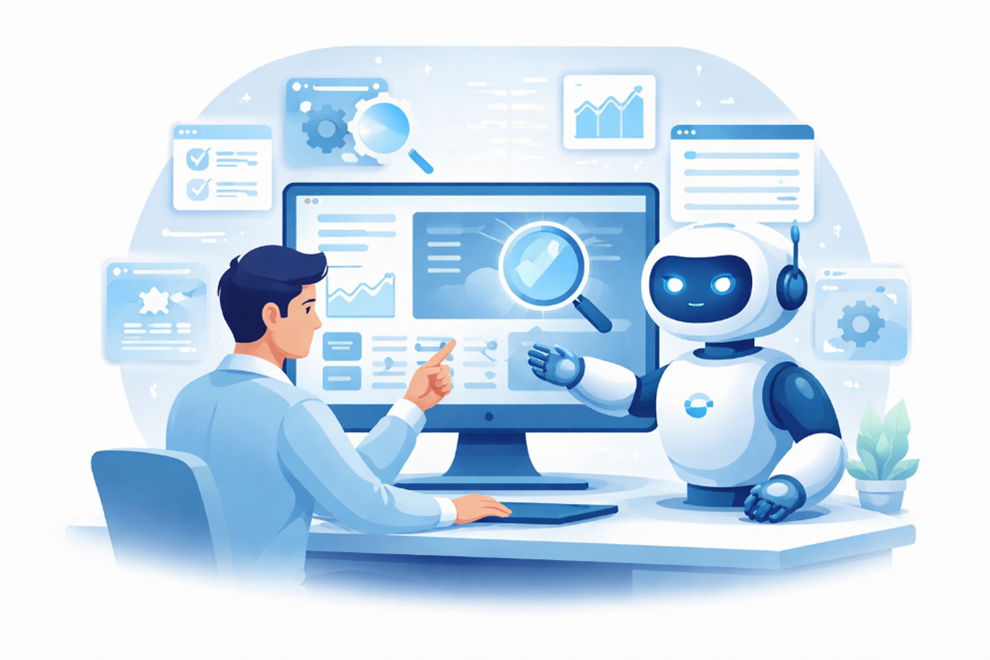
AI handles:
- Repetitive work
- Large-scale data comparisons
- Pattern spotting across thousands of logs
- Fast execution of regression scenarios
- Maintenance of automated tests when UI elements shift
It’s the support teammate clearing the field so the human tester can focus on the boss fights: complex logic, user-experience judgement, exploratory scenarios and edge cases that require creative thinking.
The tester still leads the mission. AI simply amplifies their capabilities.
AI doesn’t replace the experience of a skilled QA professional. Just as an aimbot doesn’t make someone a skilled gamer, it clears the noise, accelerates feedback, and frees testers to do their best work: think critically, explore deeply, and ensure quality with a human perspective.
Why This Matters to Your Business
Video games offer a lesson every company should take seriously: users will abandon anything that’s buggy, slow, or frustrating. The same standards gamers expect from entertainment apply to enterprise software, customer portals, mobile apps, and internal tools.
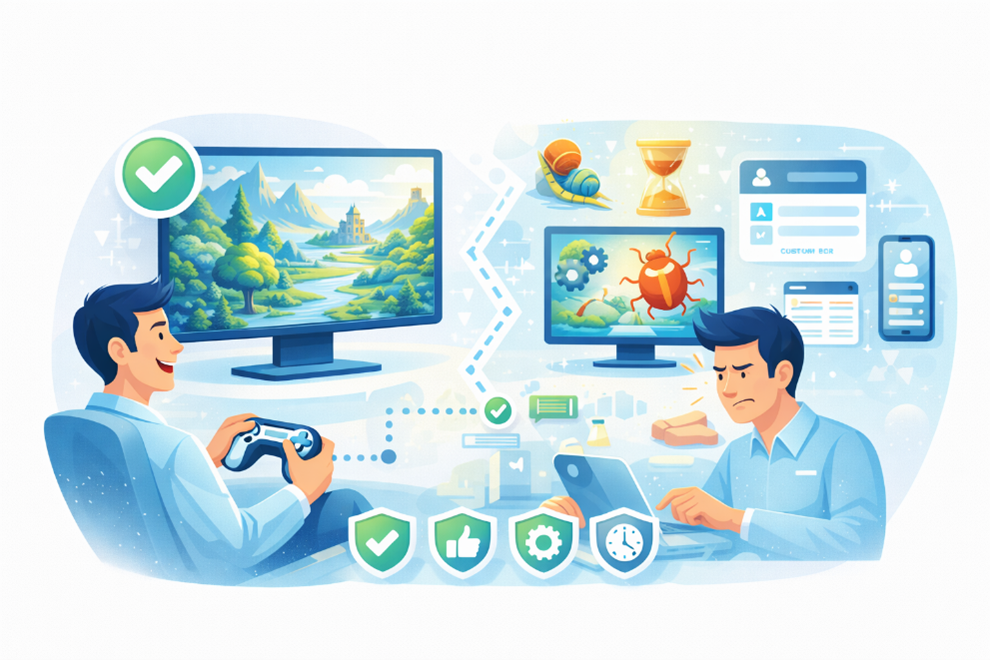
Investing in strong QA results in:
- Smoother releases
- Higher user satisfaction
- Fewer costly defects
- Faster delivery
- Stronger trust in the product
The connection between gaming and testing becomes a useful way to explain why QA matters. When the experience suffers, people don’t stick around. Quality is what keeps them in the game.
Final Thoughts
Whether you’re navigating a dangerous dungeon or testing a complex enterprise system, the principle is the same: great experiences are built on careful design, thorough testing, and respect for the user. Video games remind us how quickly a bug can ruin immersion – and how rewarding it is when everything works just right.
QA keeps both worlds running smoothly. And as AI continues to evolve, testers and technology will work together like a well-coordinated co-op team, elevating quality to a whole new level.
If you’re evaluating your QA maturity or exploring how AI-augmented testing could accelerate your release cycles, we’d welcome a conversation. Get in touch to learn how we can help.

Bradley Cress
- RadixBay Consultant
- IT and software-testing writer with multiple AT*SQA micro-credentials
- Google IT Support Professional Certificate
- Cybersecurity Certified
